

What Do Experts and Superforecasters Think about the Geopolitical Implications of AI?
In Wave 5 of the Longitudinal Expert AI Panel survey, we asked for forecasts on the U.S.–China AI performance gap, frontier chip manufacturing, use of autonomous cyber weapons and more.

In the latest wave of the Longitudinal Expert AI Panel (LEAP), we asked panelists to consider the geopolitical and military implications of AI. We asked questions about U.S.–China AI polarity, chip manufacturing, and cyberweapons, as well as questions about AI models’ forecasting accuracy and regulatory fines on AI companies.
Every month, LEAP tracks the views of top AI scientists, industry leaders, policy researchers, economists, and high-performing forecasters on the trajectory of the development and use of artificial intelligence. Earlier LEAP waves covered AI research and development, broad adoption of AI, using AI for science, and more.
This post covers key highlights from the Wave 5 LEAP survey that we conducted between January 12 and February 2, 2026. Full details of this wave, including question details and analysis of rationales, are available here.
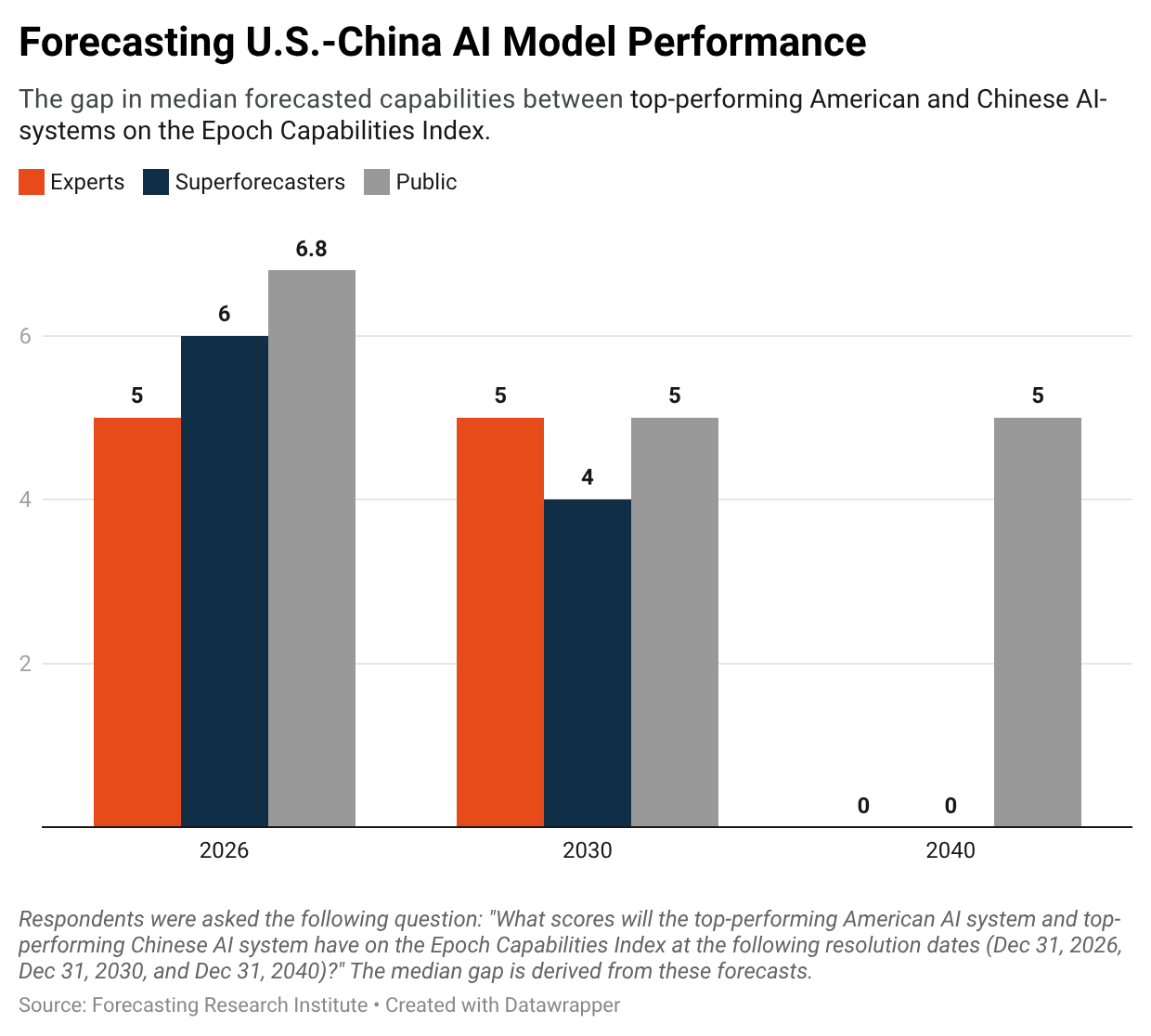
Insight 1: Experts and superforecasters expect the performance gap between U.S. and Chinese AI models to narrow by 2031, with parity anticipated by 2041
Experts and superforecasters forecast that Chinese AI systems will roughly match American ones on benchmarks by the end of 2040. At the time this survey was published (January 2026), the top Chinese models lagged behind U.S. models by nine points on the Epoch Capabilities Index. At the time of writing (February 2026), this gap is six points. The median expert expects this gap to narrow to five points by the end of 2030 and to zero by the end of 2040.1
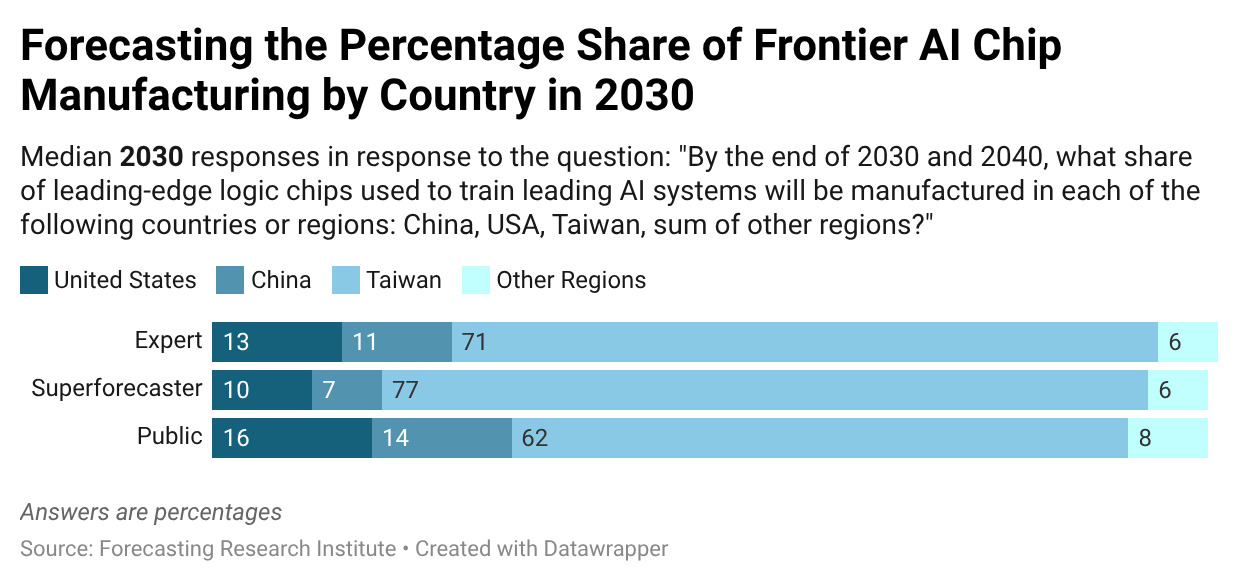
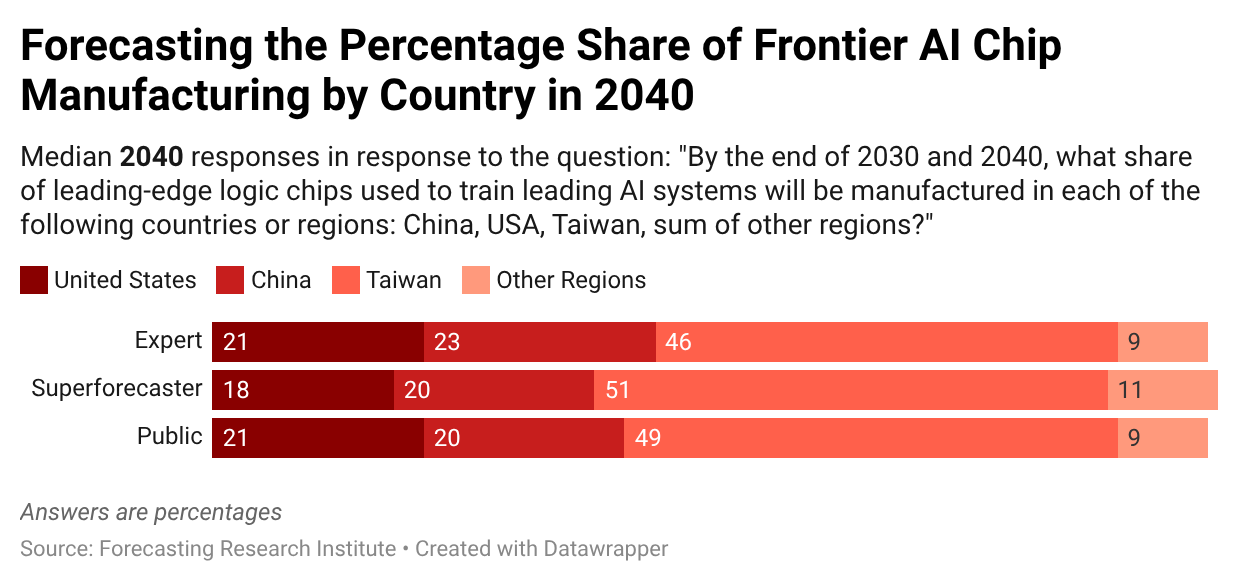
Insight 2: Experts predict that Taiwan’s dominance in leading-edge chip manufacturing will erode, with the U.S. and China becoming significant leading-edge chip manufacturers
Experts project Taiwan’s global share of leading-edge chip production to fall from over 90 percent today to roughly 71 percent by 2030 and 46 percent by 2040, with the U.S. and China each capturing around 20 percent of the market in 2040.
Forecasters cited national security concerns as the major factor driving increased U.S. leading-edge chip manufacturing, arguing that onshore chip production could serve as insurance against blockade, conflict, or disruption. Forecasters also expected China to scale up its leading-edge chip manufacturing abilities, eventually reaching technical parity with the U.S. and Taiwan.
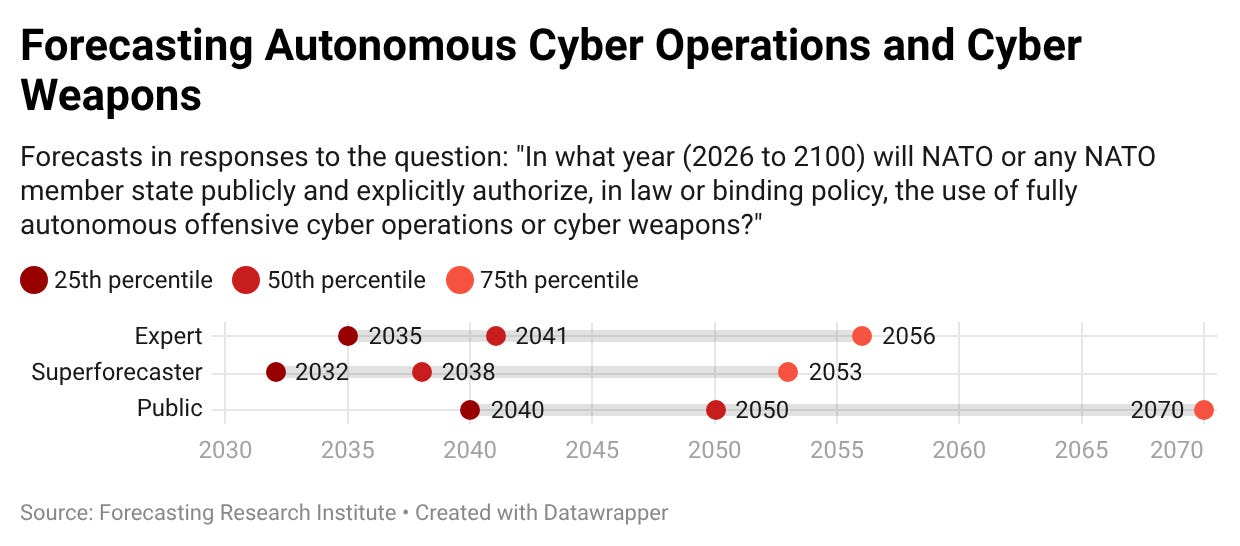
Insight 3: Experts expect a NATO member state to use autonomous cyber weapons by 2041, and that U.S.–China agreement on military AI is unlikely by this date
The median expert forecasts that NATO or a member state will publicly authorize fully autonomous offensive cyber operations in the coming decades (a median forecast of 2041), with superforecasters predicting this will occur slightly earlier, in 2038. A quarter of experts expect this policy shift to occur in 2035 or earlier.
In addition, experts gave only a 16 percent probability that the U.S. and China would sign an agreement on military AI usage by the end of 2030, but gave a 40 percent probability that such an agreement would be signed by the end of 2040. The median superforecaster agreed with these predictions, although there was widespread disagreement within each group about the likelihood of such an agreement.
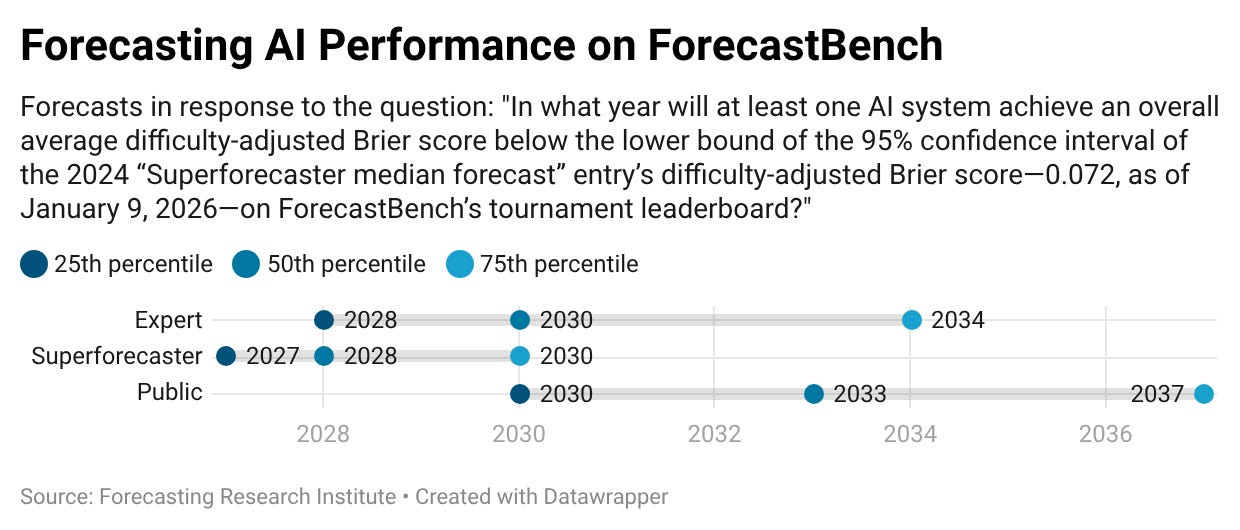
Insight 4: AI systems are expected to surpass top human forecasters within the next few years, but the significance of that achievement is debated
Superforecasters themselves are the most bullish group on automated forecasting progress, with the median superforecaster predicting AI systems will beat their ForecastBench benchmark by 2028, which is earlier than both the median expert (2030) and the median public (2033) forecast.
Insight 5: Experts expect large (>$1 billion) regulatory fines on AI companies to total a cumulative $4 billion by 2030
The median expert predicts that the U.S. and/or EU would impose $1 billion in cumulative large-scale regulatory fines on AI companies by 2027, rising to $4 billion by 2030, and $10 billion by 2040. The public consistently expected higher fines, while superforecasters gave the most conservative predictions, estimating $8 billion in fines by 2040.
Forecasters cite AI-driven financial fraud, disinformation campaigns, sexual victimization through “deepfakes,” and copyright violations as potential trigger points for fines, but were skeptical that major fines would be levied by the end of 2027, pointing out that there have been few examples of such fines so far.
Find out more about LEAP
To read more about Wave 5 of LEAP, including further questions and rationale analysis, visit the LEAP website. If you have a suggestion for a question you’d like to see covered in a future LEAP wave, please submit a question through our online form.
We did not directly ask forecasters to predict the gap between U.S. and Chinese model performance. Instead, we compute the gap from separately elicited forecasts for each. The reported gap may differ slightly from what forecasters would report if asked directly.