

Forecasting Major Risks from AI
In Wave 9 of LEAP, we gathered forecasts about catastrophic risk from AI, major harm events, democratic backsliding, cybercrime, and asked when a major government will restrict an AI model release.

In the latest wave of the Longitudinal Expert AI Panel (LEAP), we asked AI experts, superforecasters, and members of the general public to consider how major risk vectors may be influenced by AI. We asked forecasters to consider the likelihood of a major catastrophe from any source leading to the deaths of more than 10% of the world population, as well as a catastrophe on that scale directly caused by AI.
We also asked for forecasts on the likelihood of a smaller-scale AI harm event, financial loss from cybercrime, the chance of top-ten economies backsliding into authoritarianism, and the probability of a major government restricting an AI model release. For many of these questions, we asked forecasters to consider specific AI progress scenarios, allowing us to partially identify the additional risk posed by rapid near-term AI progress.
The next LEAP wave will focus on the benefits of AI. We’ll release those forecasts in our next LEAP wave report and expect them to pose an interesting counterpoint to the forecasts below.
This post covers key highlights from the Wave 9 LEAP survey that we conducted between May 19 and June 10, 2026. Recent waves covered robotics, the economic effects of AI, security and geopolitics, AI R&D, and AI timelines. More information about Wave 9, including question details and analysis of rationales, is available here.
Insight 1: Experts and superforecasters think a major AI-driven harm event is more likely than not by 2050
We asked forecasters about the probability of an AI-driven event causing the deaths of at least 50 people or $100 billion in damages before the end of 2050. The median expert gave a 62% probability that this would occur by 2050, while the median superforecaster predicted 70%. Both of these forecasts are considerably above the general public’s expectations—they assigned a 35% probability to this outcome.
Conditional on a major AI-driven harm event occurring, both experts and superforecasters gave 50% odds that this would happen by 2035. Both groups gave a one-in-four chance of such an event happening by 2031. Most commonly, forecasters expected such events to arise from AI-introduced errors in critical infrastructure systems and cyberattacks, followed by autonomous or AI-assisted military systems. Below these, transportation accidents and deliberate human weaponization of AI form a secondary tier.
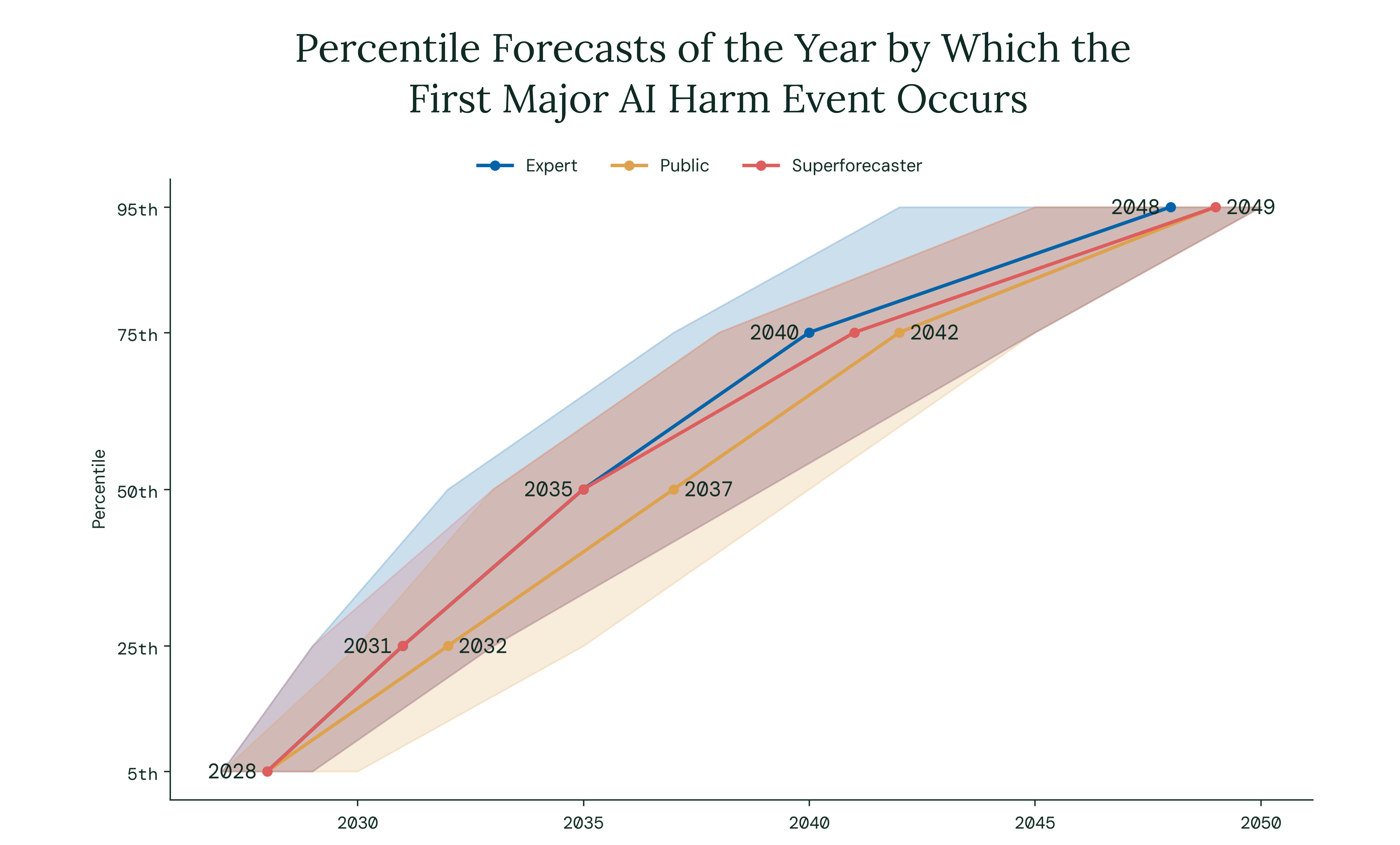
Insight 2: If AI capabilities progress rapidly, forecasters predict a roughly 5x increase in the probability of a global AI-related catastrophe, compared with a world with slow AI progress
We also asked forecasters to predict the likelihood of a global AI-related catastrophe in which more than 10% of the people alive at the start of a five-year period die by the end of that period. If AI capabilities progress slowly, the median expert assigns this a 0.08% probability by 2030, 1% by 2050, and 2% by 2100. In a scenario where AI progress by 2030 is rapid, those forecasts rise to 1%, 5%, and 10%.1
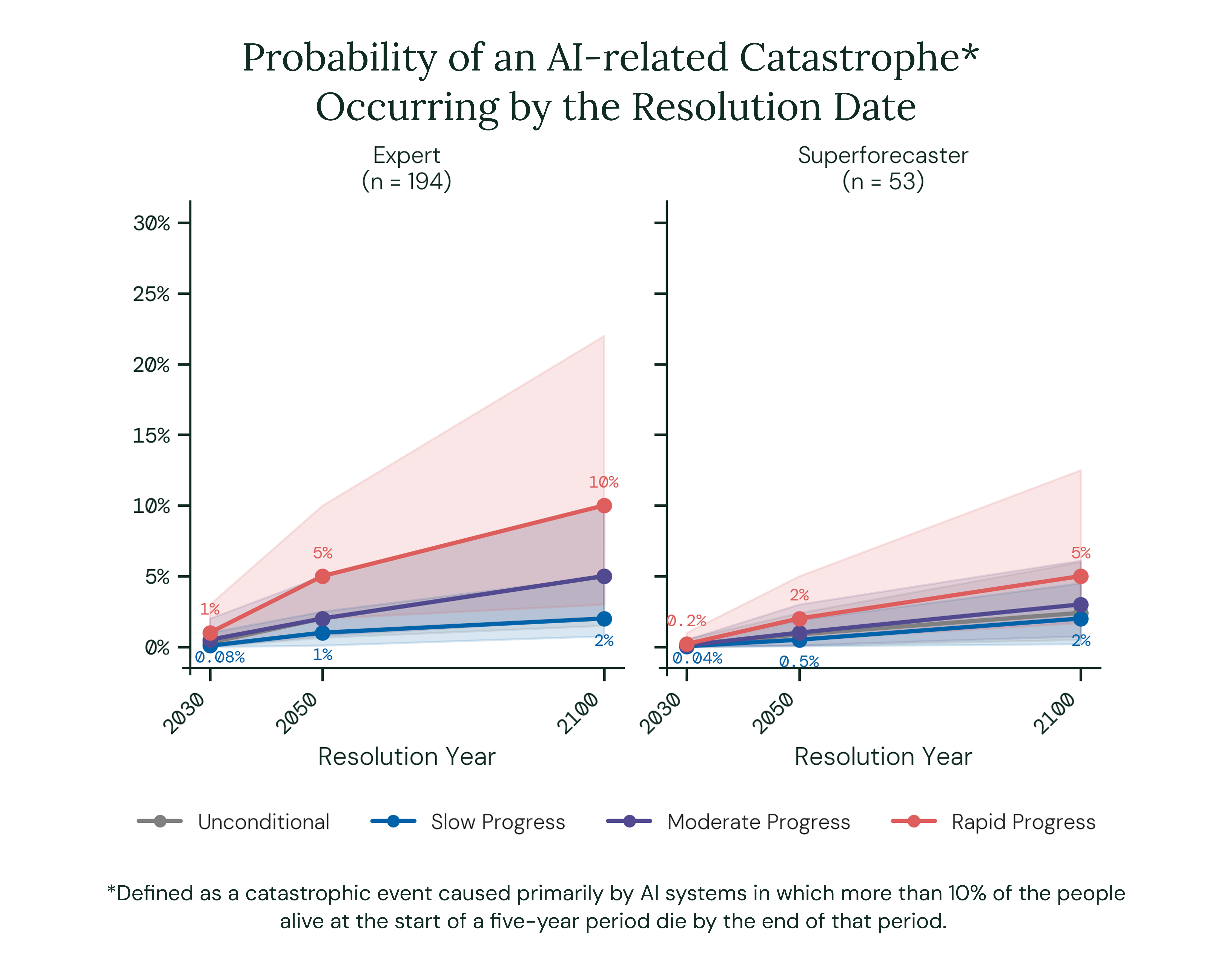
Our slow progress scenario describes a world in which AI is merely a capable assistant to human workers, while our rapid scenario depicts AI that can match or surpass the best humans across cognitive and physical tasks. Expert forecasts, then, predict that moving from the slow world to the rapid world also implies a five-fold increase in the risk of a deadly AI-related global catastrophe.
In their written rationales, both optimistic and pessimistic forecasters agreed that faster progress raises risk because it compresses the time available for policy and society to adapt. However, forecasters disagreed on how likely it was that a catastrophe would meet the threshold of killing 10% of the global population, with some expecting warning events to trigger protective mandates before this threshold was reached.
Insight 3: If AI capabilities advance rapidly, experts attribute roughly two-thirds of all global catastrophic risk this century to AI
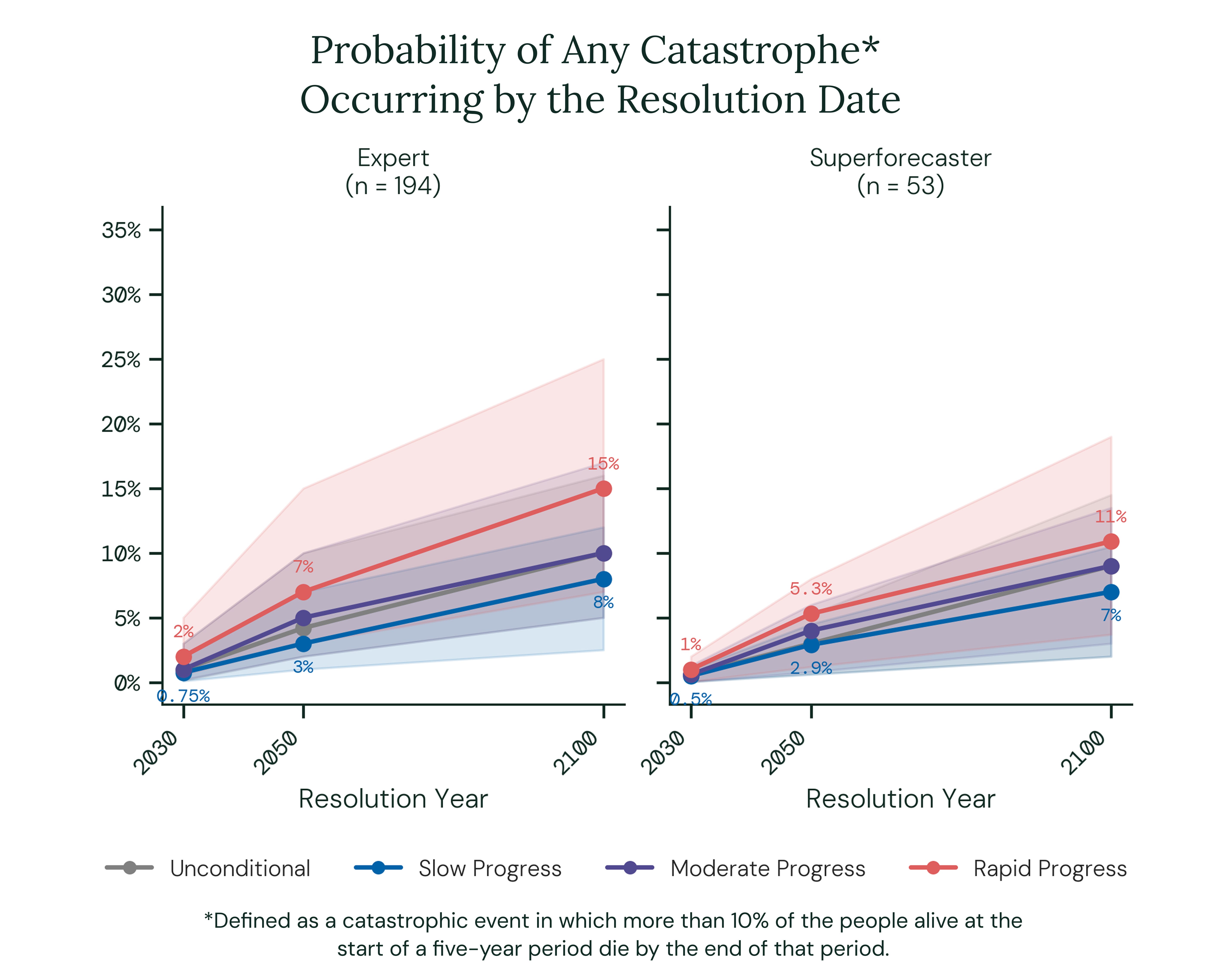
We also asked respondents for the probability of a global catastrophe from any cause—again defining catastrophe as the death of more than 10% of the people alive at the start of a five-year period. Conditional on AI capabilities progressing rapidly by 2030, the median expert forecasts the probability of an AI-related catastrophe by 2100 at 10% compared with 15% for a catastrophe from any cause.
We computed each respondent’s ratio of AI catastrophic risk to total catastrophic risk. The median expert attributes about two-thirds (67%) of total global catastrophic risk to AI in a world where AI capabilities progress rapidly, but roughly 30% in a slow progress world.
In their rationales, forecasters who assigned a higher share of total catastrophic risk to AI argued that the technology is becoming so entangled with every catastrophic pathway that a genuinely AI-free catastrophe is hard to imagine. Those who saw AI catastrophic risk as a smaller percentage rejected the premise that AI is entangled with everything, treating the dominant non-AI pathways as substantial standalone risks.
Insight 4: Experts and superforecasters give a 50% chance that a major government restricts an AI release by 2030
The median expert and superforecaster assign a 50% chance to the U.S., UK, or EU restricting the initial public release of an AI system on safety grounds by 2030. The median expert gives 25% odds of this happening by 2028 and 75% by 2034.
On June 12, shortly after our survey closed, the U.S. government issued an export-control directive suspending access by any foreign national to Anthropic’s Mythos 5 and Fable 5 models. As this happened after the models were released, this did not meet our resolution criterion that such a directive must restrict the system’s release. We will monitor ongoing news surrounding GPT-5.6 and related models to see if near-term government actions meet the criteria.
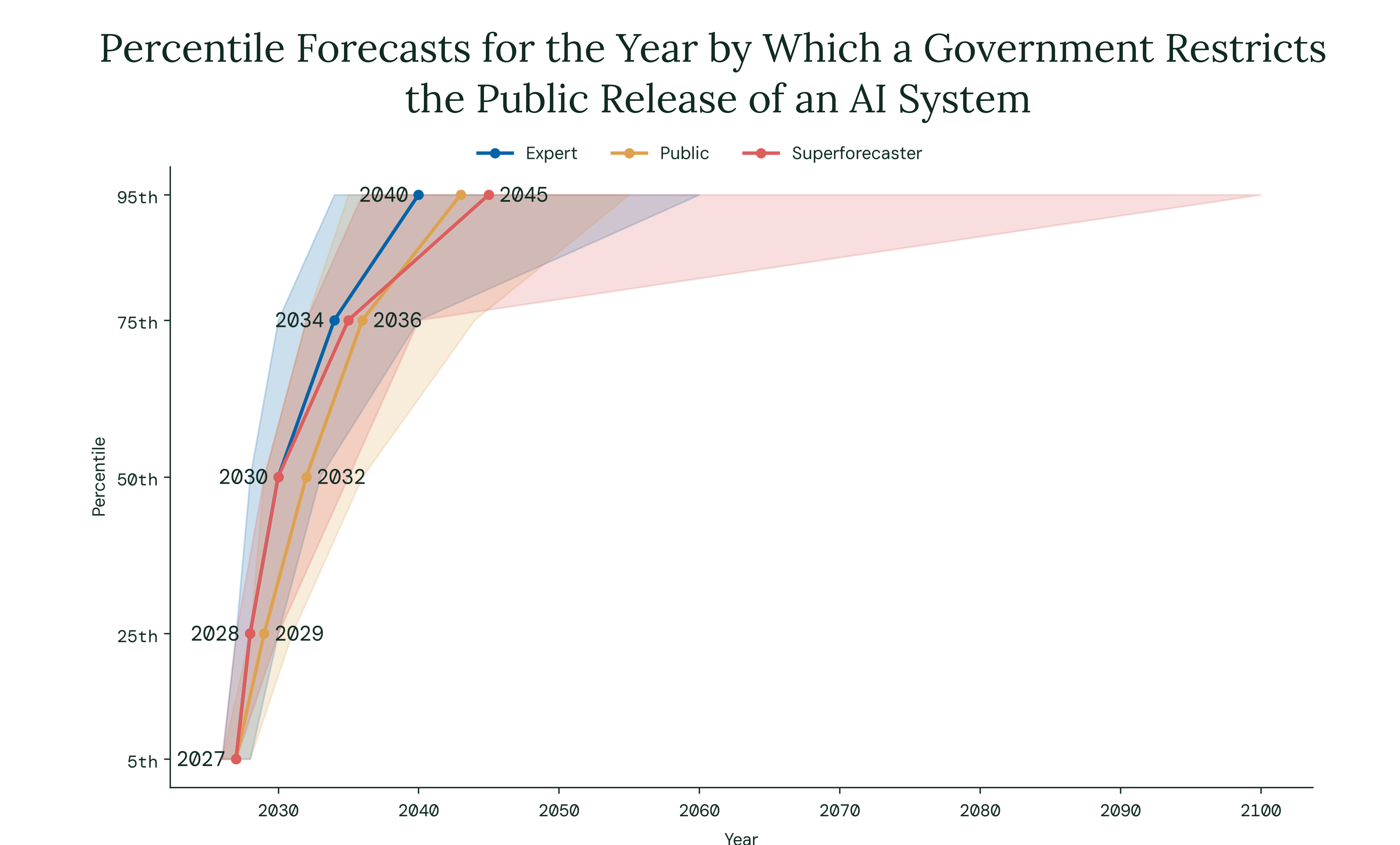
Early-restriction forecasters read Anthropic’s voluntary withholding of its Mythos model as evidence the dangerous-capability threshold has arrived, and pointed to the EU AI Act’s Article 93 powers that take effect in August 2026 as the earliest plausible trigger. Late-restriction forecasters argued that voluntary industry restraint substitutes for state action and that governments typically regulate deployment and use rather than pre-release publication.
Insight 5: Experts predict a roughly 25% chance that two more of the world’s current eight largest democracies will backslide into authoritarianism by 2040 if AI progress is rapid
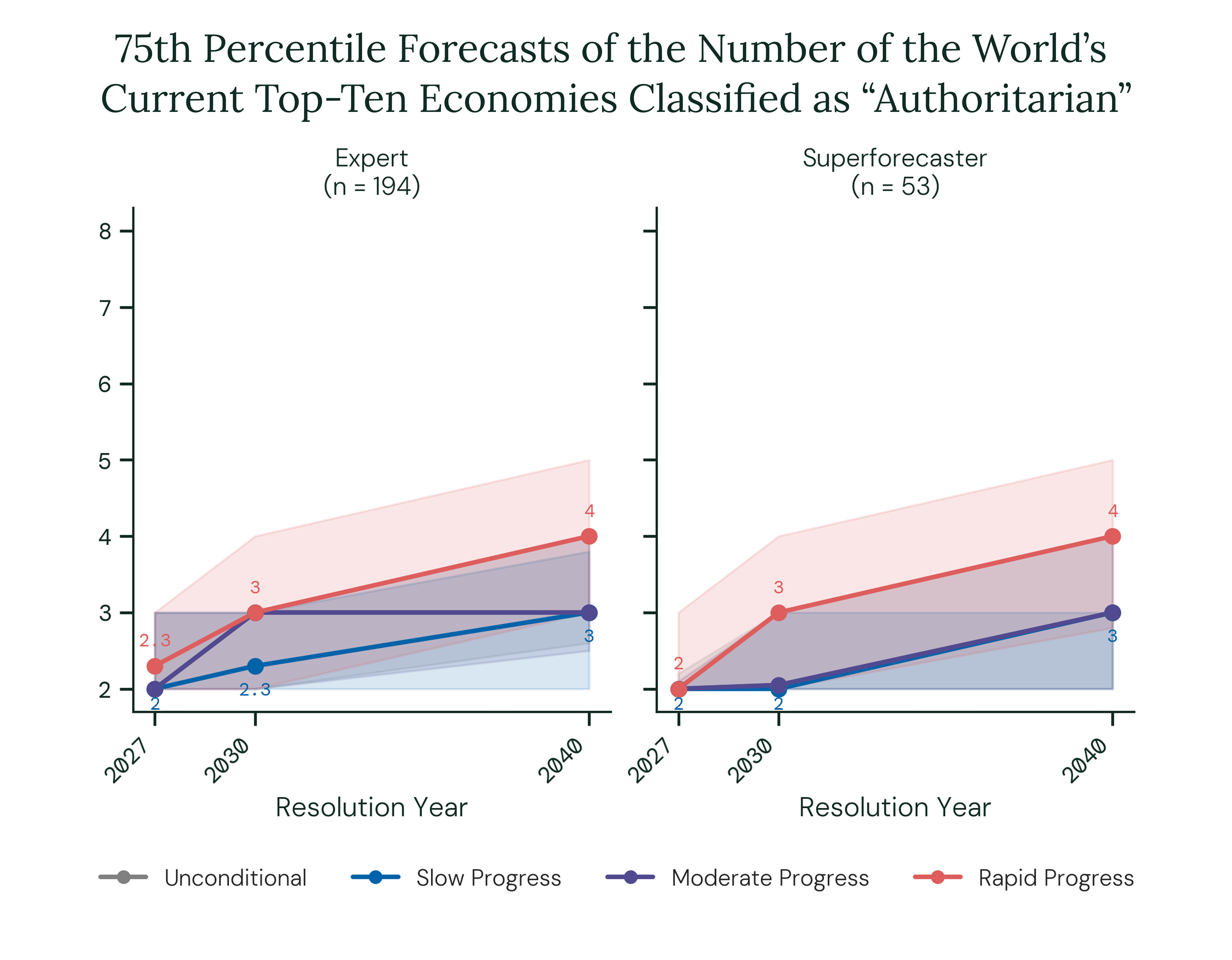
Two out of the world’s ten largest economies are currently classified as “authoritarian” on the Economist Intelligence Unit (EIU) Democracy Index: China and Russia. In an unconditional scenario, the median expert and superforecaster expect that count to stay at roughly the same level through 2040.
However, if AI progress is rapid, the median expert assigns a roughly 25% chance of two of today’s eight largest democracies (the U.S., Germany, Japan, UK, India, France, Italy, and Canada) backsliding into authoritarianism, bringing the total to four or more authoritarian states among the top-ten economies by 2040, and a 5% chance the total reaches five or more. Those assigning higher counts argued that rapid AI progress amplifies the tools of surveillance, censorship, and repression and widens the range of political outcomes, disproportionately adding probability to less democratic results.
Insight 6: Experts predict that cybercrime losses by 2031 would be roughly 52% higher in a world where AI capabilities progress rapidly compared with a world with slow AI progress
In 2025, the FBI reported nearly $21 billion in financial losses from cyber-enabled crime—more than double the figure in 2022 ($10.3 billion). If AI capabilities progress slowly through 2030, the median expert predicts that losses reported to the FBI will increase to $25 billion in 2026, $35 billion in 2028, and $46 billion in 2031. If AI progress is rapid by 2030, they predict reported losses of $31 billion, $50 billion, and $70 billion, respectively. In a rapid-progress world, experts give a one-in-four chance that losses are $93 billion or higher by 2031.
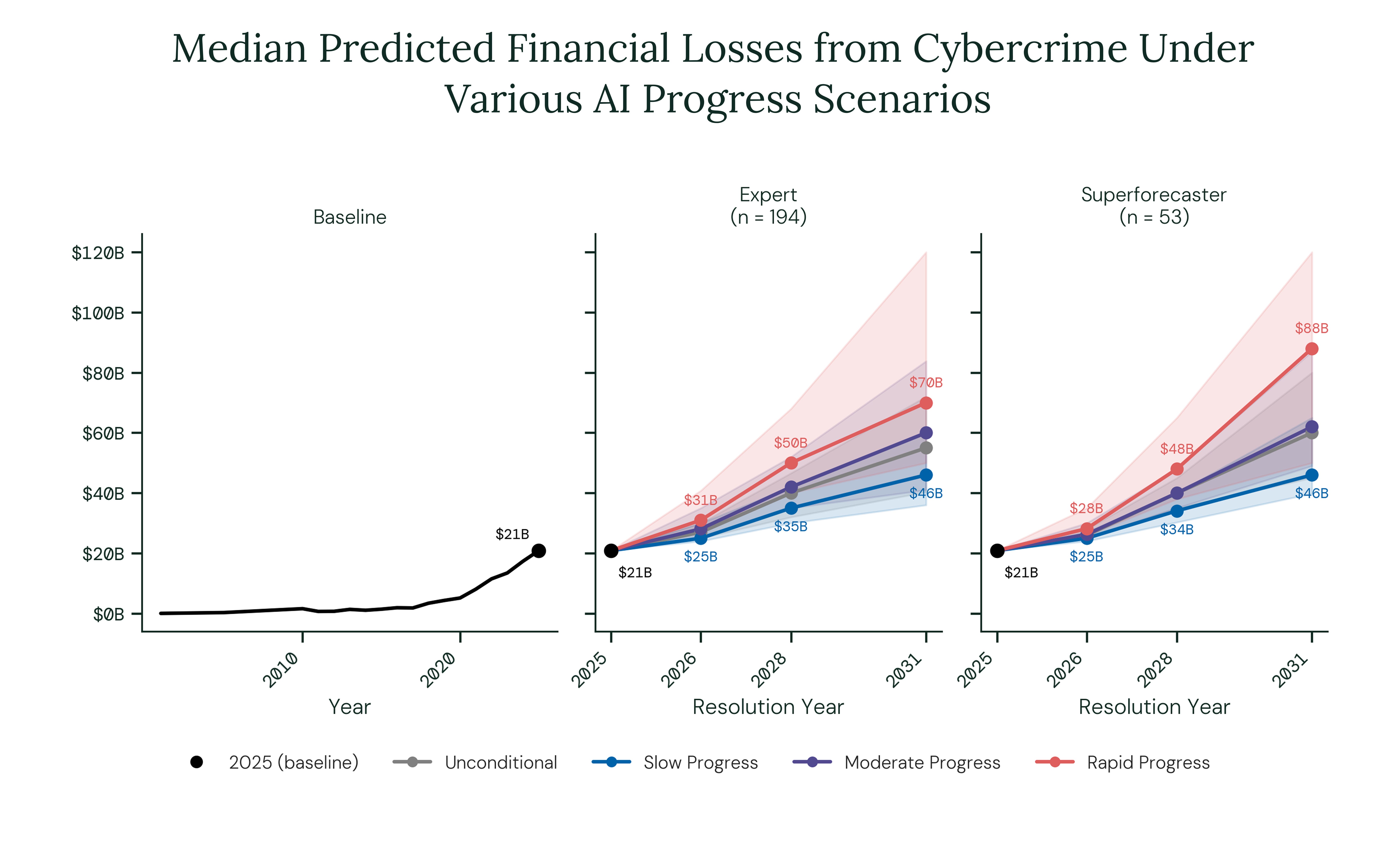
Many respondents reported that AI-enabled deception would be a primary driver of future losses, citing deepfakes, automated targeting, and personalized messages as factors that would increase the rate of fraud. Forecasters who predicted high cybercrime losses argued that AI advantages attackers, with defenders structurally disadvantaged and legacy systems and human behavior remaining highly vulnerable to attacks.
Find out more about LEAP
To read more about Wave 9 of LEAP, including further questions and rationale analysis, visit the LEAP website.