

Experts and Superforecasters Update Their AI Timelines
In Wave 8 of the Longitudinal Expert AI Panel we asked panelists to forecast AI's overall impact on human society, AGI timelines, near-term progress on METR's time horizon benchmark, and more.

In the latest wave of the Longitudinal Expert AI Panel (LEAP), we asked AI experts, superforecasters, and members of the general public to consider the long-term capabilities and impact of AI. For the first time, we gathered updates on a question we asked in the very first LEAP wave back in the summer of 2025—asking panelists to forecast AI’s impact on human society by 2040.
We asked panelists for their predictions on AGI timelines,1 near-term progress on METR’s task-completion time horizon benchmark, the factors that will enable or block AGI by 2040, and timelines for a “rapid AI progress” scenario. We also asked panelists to assess AI’s overall impact on the U.S. over the next 20 years and its effects on people’s ability to solve problems, make difficult decisions, form meaningful relationships, and think creatively.
Every month, LEAP tracks the views of top AI scientists, industry leaders, policy researchers, economists, and high-performing forecasters on the trajectory of AI’s development and use. Recent waves covered robotics, the economic effects of AI, security and geopolitics, and AI R&D. You can see a full list of LEAP questions and forecasts here.
This post covers key highlights from the Wave 8 LEAP survey that we conducted between April 20 and May 11, 2026. More information about this wave, including question details and analysis of rationales, is available here.
Insight 1: Experts and superforecasters have updated their expectations of AI’s impact upward in the last nine months
Back in June/August 2025, we asked LEAP panelists to assess the likelihood of AI in 2040 reaching various levels of impact on the Technological Richter Scale (TRS)—a scale devised by Nate Silver to rank technologies according to their broad societal impact. Credit cards, for example, are ranked as a “technology of the decade” (Level 7) while the rise of humans ranks as a “technology of the epoch” (Level 10). You can view the forecasts from the first time we asked the question here.
We repeated this question in the current April/May 2026 wave, nine months after we first asked for forecasts. Experts and superforecasters have increased the likelihood they assign to AI’s impact being comparable to higher levels of technological importance, more akin to a “technology of the millennium” (e.g. agriculture, Level 9), but experts continue to assign the greatest probability to AI being comparable to “the technology of the century” (e.g. electricity, Level 8).
On average, experts assign a 35% chance of AI reaching TRS Level 8 by 2040, with substantial weight on Level 9 (24%) and Level 10 (11%). Superforecasters gave a near-identical distribution (34% to Level 8, 23% to Level 9, 8.5% to Level 10), while the public is meaningfully more conservative.
Among the 264 expert and superforecaster participants who completed both Wave 1 and Wave 8, the mean expected TRS levels rose for experts by +0.20 (from 7.86 to 8.06), with larger movement among superforecasters (+0.39, from 7.50 to 7.89) and minimal movement among the public (+0.07, from 7.18 to 7.25). 74% of participants remained within ±1 point of their Wave 1 forecast, while 15% increased and 11% decreased by more than one point.
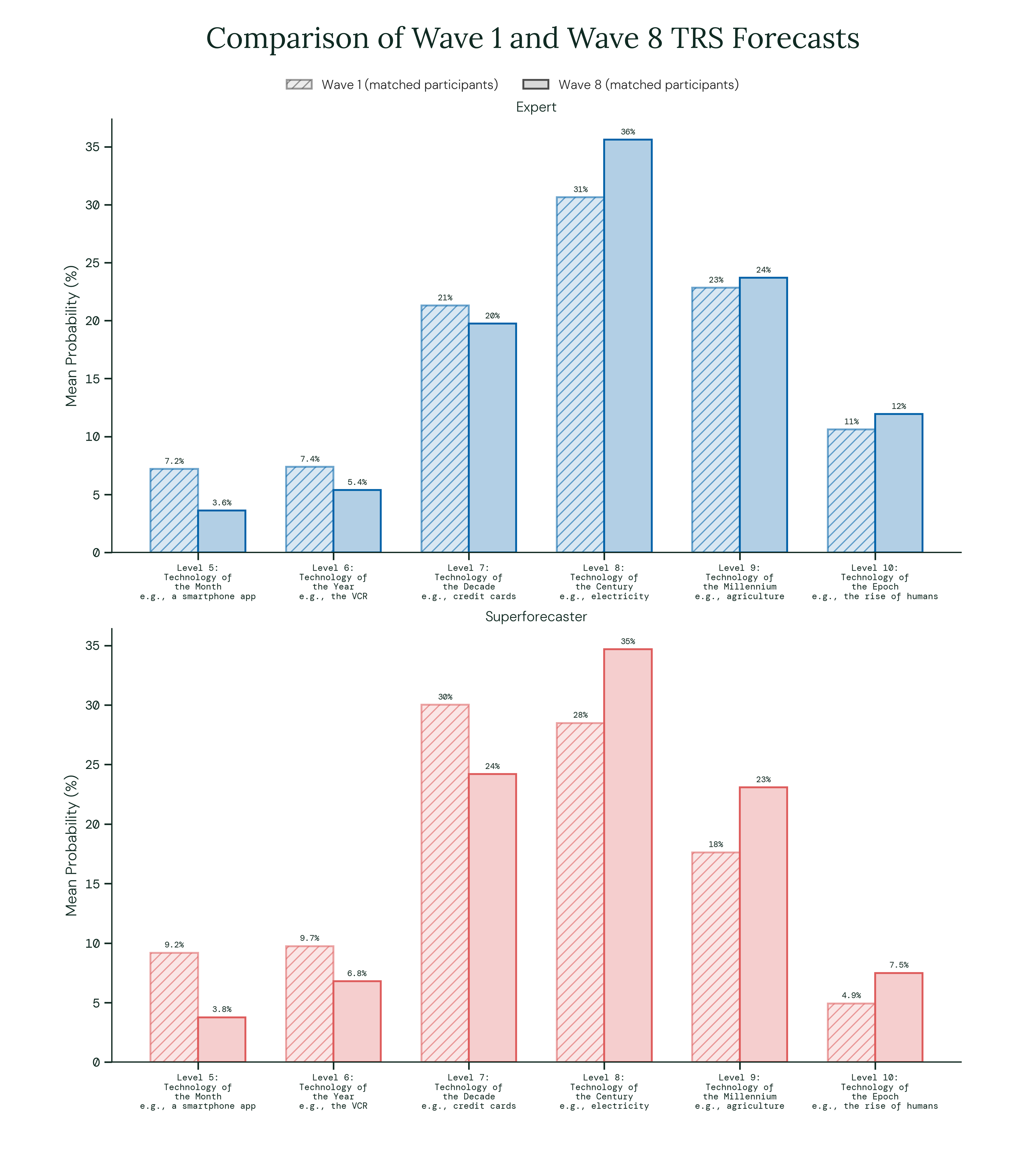
This shift is also visible in participants’ modal forecasts—the level each person assigns the highest probability to. Among matched experts, the share whose modal forecast is “technology of the century” grew from 38% to 53%. Superforecasters showed a more pronounced change: “technology of the decade” was the most common modal choice in Wave 1 (38% of superforecasters), but this was replaced by “the technology of the century” in Wave 8 (43%).
Insight 2: Most experts expect “AGI” before 2100, with a median forecast that it will occur by 2050
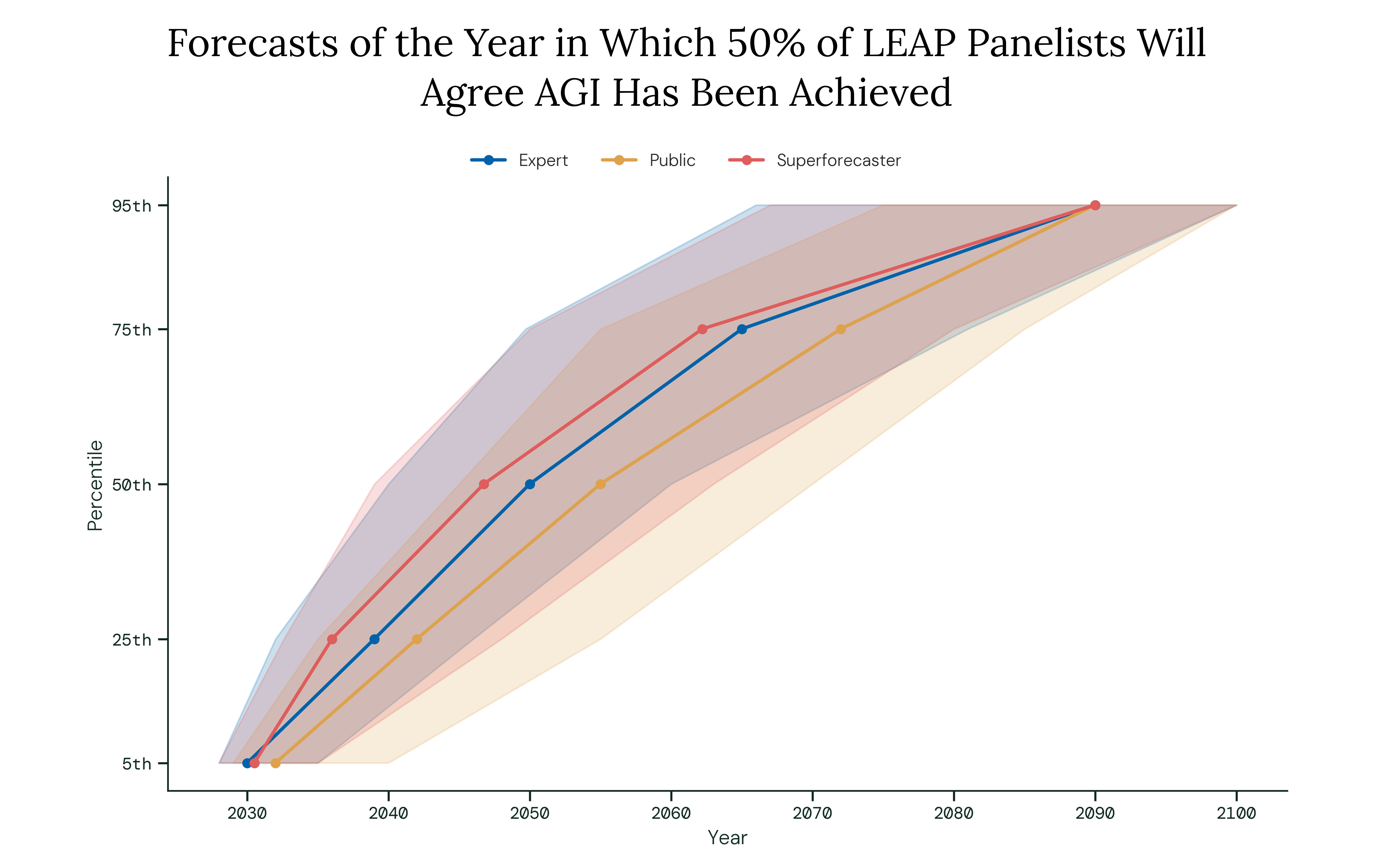
We asked respondents for the probability that, before 2100, more than 50% of LEAP panelists will agree that artificial general intelligence (AGI) exists and—if such a scenario occurs—the year in which they expect this to happen. We defined AGI as a commercially available AI system that meets both of the following criteria:
Can outperform the 90th percentile professional human employee in every primarily non-physical occupation (based on 2025 performance), across all sectors, on at least 90% of the economically useful non-physical tasks that they perform.
Has an inference cost no more than 5x the cost of equivalent human labor.
The median expert forecasts an 80% probability that the majority of LEAP panelists will agree AGI exists before 2100 according to this definition. Conditional on this occurring, experts give a median forecast of this occurring in 2050, with a 25% probability by 2039 and a 75% probability by 2065. Superforecasters give a similar median probability (80%) and a slightly earlier median year of occurrence (2047).
Insight 3: Experts predict that AI will be able to complete eight-hour tasks with 80% success by 2030 on METR’s task-completion time horizon benchmark
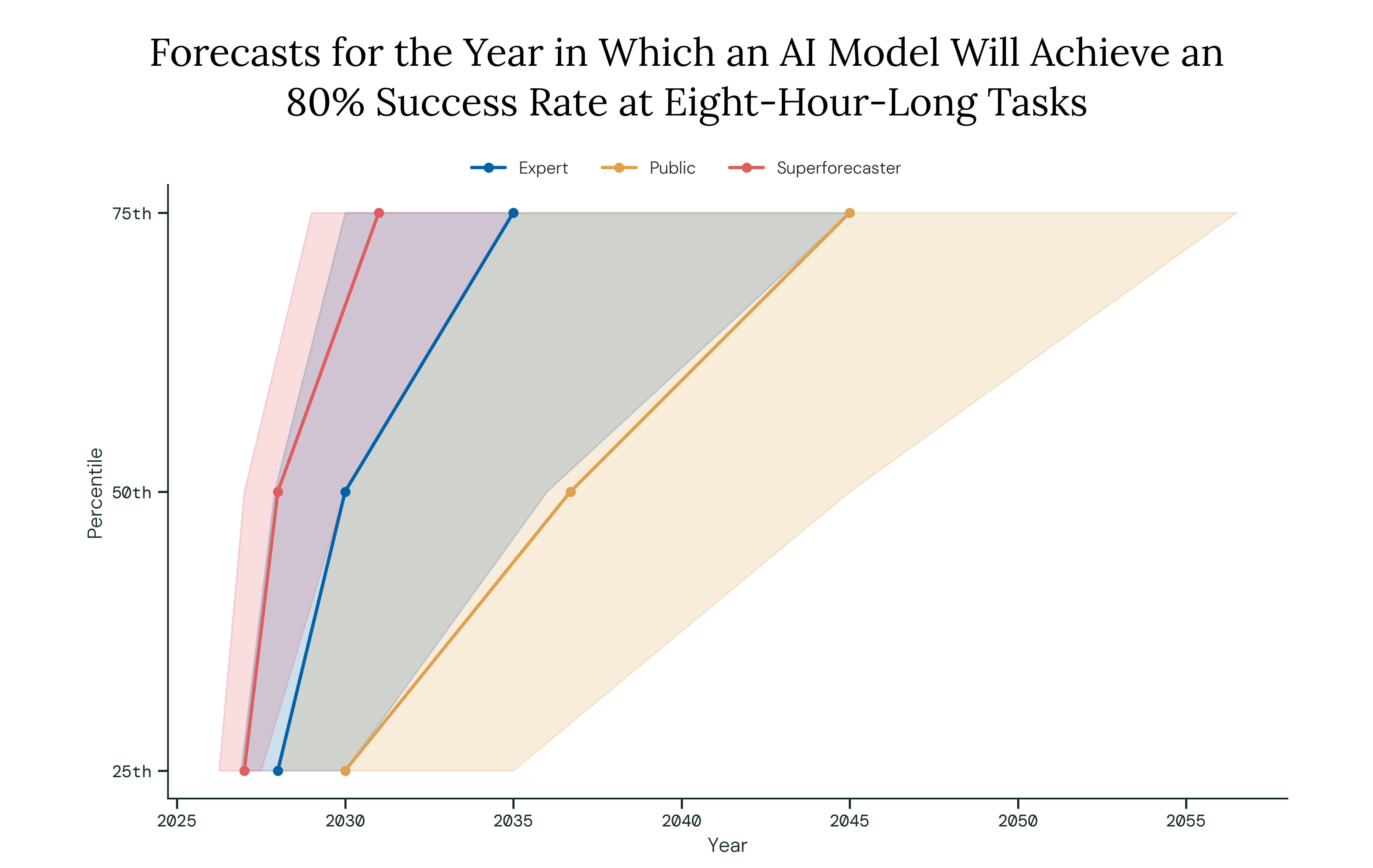
When asked when an AI model will achieve 80% success on software tasks requiring 8 hours or more of human expert effort, the median expert gives a 50% probability of 2030 or earlier. The median superforecaster reports more aggressive timelines, forecasting 2028, while the public forecasts a significantly slower timeline of 2037 at the median.
We also asked forecasters to predict the longest 80% success time horizon achieved by the end of 2026, and all three groups’ medians were between 3 and 4 hours (experts 3.4, superforecasters 3.5, public 3), up from a baseline of 1.5 hours at time of survey launch (April 20, 2026).
On May 8, 2026 (toward the end of our survey period), METR updated its benchmark to include a preview of Anthropic’s Mythos model. The model achieved an 80% time horizon of 3 hours and 6 minutes, already within the range of the median expert and superforecaster predictions with more than seven months remaining in 2026.
Insight 4: Experts and superforecasters tend to view AI more optimistically than the general public
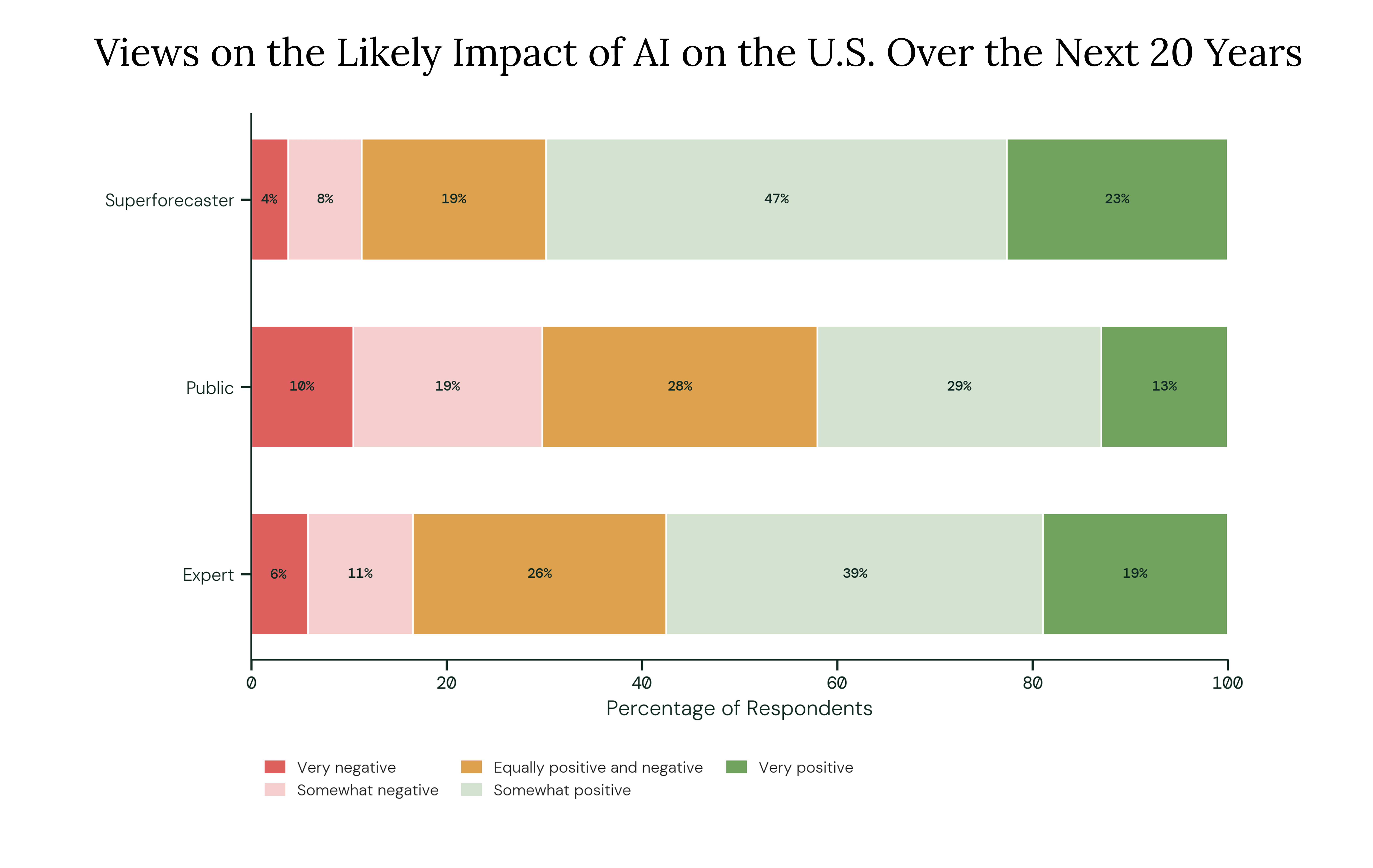
We asked panelists for their views on AI’s impact on the U.S. over the next 20 years. We asked for their broad predictions as well as more specific forecasts as to whether AI will make people better or worse at thinking creatively, making difficult decisions, solving problems, and forming meaningful relationships with other people.
When asked about AI’s overall impact over the next 20 years, 57.5% of experts and 69.8% of superforecasters predict a somewhat or very positive impact, compared to 42.0% of the public. The divergence is sharpest on problem-solving (72.7% of experts and 69.8% of superforecasters say AI will make people better at this, compared to 48.6% of the public) and on making difficult decisions, where 58.3% of experts expect improvement compared to just 36.9% of the public, 39% of whom expect people to become worse at this.
One area in which experts’ and the public’s views converge is about AI’s impact on forming meaningful relationships: 68.4% of experts and 66.7% of the public expect people to become worse at this, in contrast to just 50.9% of superforecasters expecting this.
Find Out More About LEAP
To read more about Wave 8 of LEAP, including further questions and rationale analysis, visit the LEAP website.
We defined this as the first year a commercial AI system outperforms the top human performance on the vast majority of non-physical work tasks.