

Experts Forecast Rapid AI Progress Could Bring Health and Wealth Without Happiness
In Wave 10 of LEAP, forecasters share their predictions on the potential benefits from AI, including fewer deaths, longer life spans, and more wealth. Plus, we explore how much people value AI.

In the previous wave of the Longitudinal Expert AI Panel (LEAP), we asked our forecasters to consider major risks that might come from AI: global catastrophes, rising authoritarianism, and cybercrime. This month we’re exploring some of the potential upsides that AI offers: health, longevity, wealth, and happiness.
These forecasts hint at the ways that rapid AI progress could change the world for the better: over a million fewer deaths from currently non-eradicable diseases, a 10-year jump in life expectancy, and a doubling of GDP growth in advanced economies. Yet even as forecasters expect AI to deliver large, measurable gains in health and wealth, many doubt these gains will change how satisfied people feel with their lives. Forecasters also argued that the benefits of rapid AI progress are unlikely to be evenly distributed across the globe.
We asked our forecasters for predictions on the following subjects, conditional on different levels of AI progress by 2030 and at a range of time horizons:
Global deaths from non-eradicable diseases
U.S. life expectancy
GDP growth in advanced and developing economies
How much users value AI
Self-reported life satisfaction
More information about Wave 10, including question details, full AI progress scenario descriptions, and analysis of rationales, is available here.
Insight #1: If AI progress is rapid, experts forecast 500,000 annual deaths from tuberculosis, HIV/AIDS, and malaria in 2050, compared with 1.65 million deaths if AI progress is slow
In 2023, about 2.5 million people died from tuberculosis, HIV/AIDS, and malaria—three prominent diseases currently considered non-eradicable. If AI capabilities progress slowly, the median expert forecasts 1.65 million combined deaths from these diseases in 2050. But if AI progress is rapid, this number falls to 500,000—a difference of about 1.1 million deaths a year.
In the slow progress scenario, experts predict deaths in 2050 from TB, HIV/AIDS, and malaria to fall by about 34% relative to 2023 levels. In the rapid scenario, they predict deaths to fall by about 80% relative to 2023 levels. The same pattern holds across superforecaster and public predictions, although with smaller gaps between the rapid and slow AI progress scenarios.
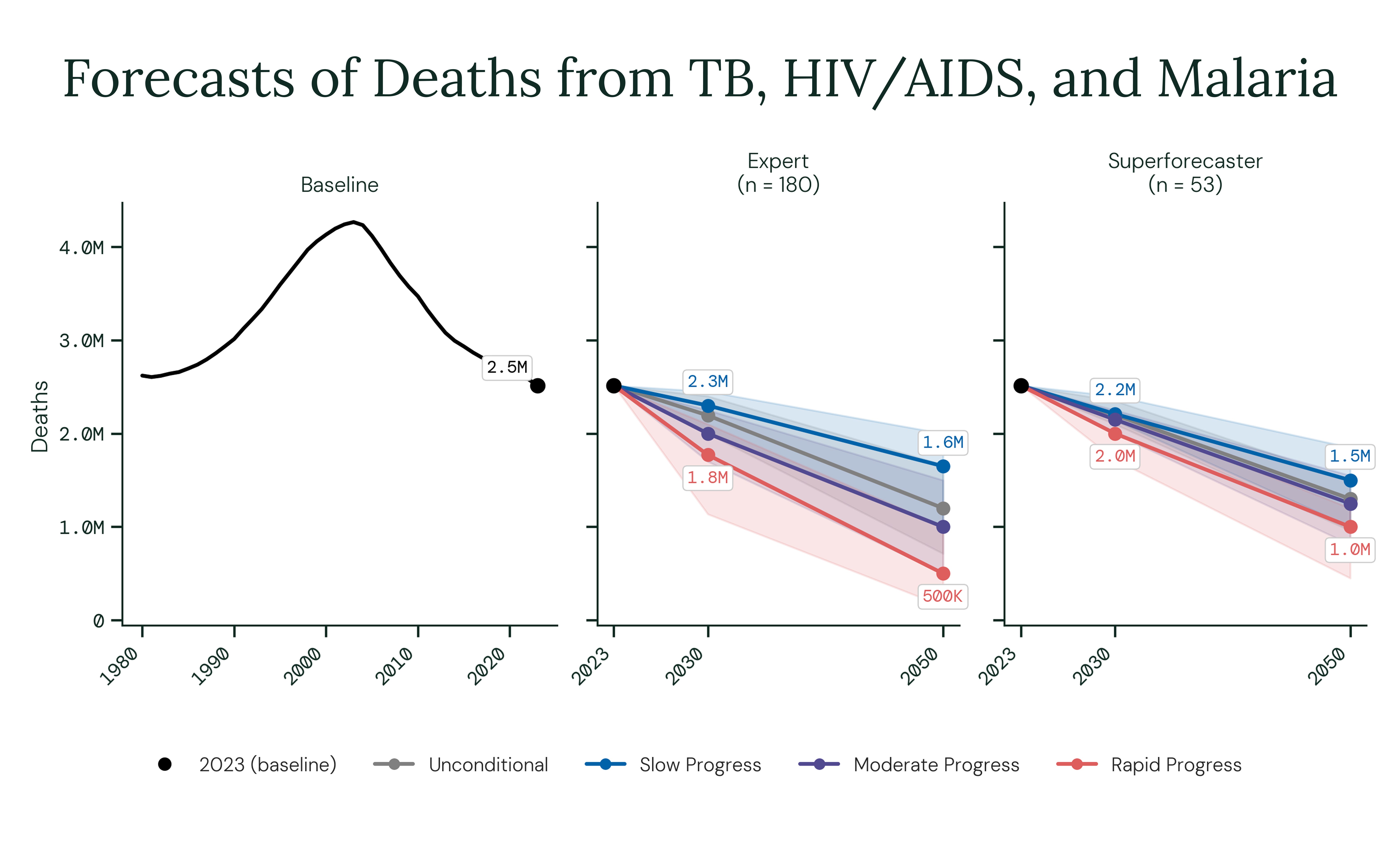
In their written rationales, many forecasters were skeptical that AI-discovered treatments would be a key factor in reducing deaths from non-eradicable diseases in the near term. They cited inadequate health systems and poverty as the reasons high death levels persist. On the other hand, several forecasters pointed to the potential for AI to alleviate poverty and, by extension, reduce deaths from disease in the regions where these deaths are highest.
Insight #2: Experts forecast that rapid AI progress would increase U.S. life expectancy by almost 16 years in 2100, compared with just six years if AI progress is slow
U.S. period life expectancy rose about 13 years between 1946 and 2023, to its current level of 79 years. If AI progress is slow, the median expert expects life expectancy to increase to 85 years by 2100, but if AI progress is rapid, they expect life expectancy by 2100 to reach 95 years. This gap between a slow-AI and a rapid-AI world is a full decade of life expectancy—comparable to most of the gains the U.S. has made since 1950.
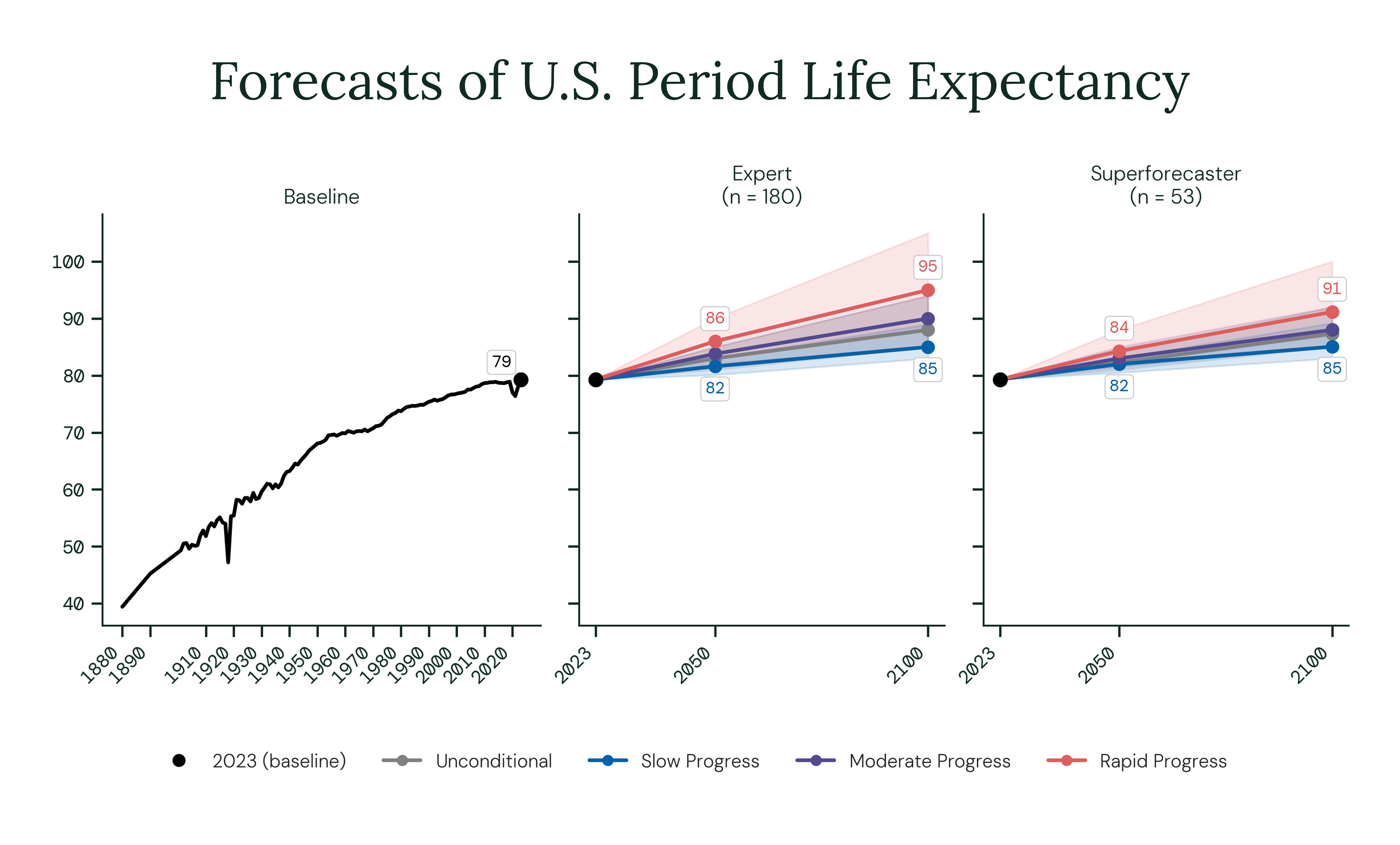
Although almost all forecasters thought period life expectancy would rise between 2050 and 2100, many expressed through their written rationales that the gains would be unevenly distributed across the income spectrum. Optimists, on the other hand, thought that AI would address the top sources of mortality in a way that was broadly accessible to all Americans. Others pointed to the life expectancy in countries such as Monaco and San Marino, arguing that the U.S. could catch up to the existing frontier.
Insight #3: Experts expect developing economies to see smaller GDP gains from rapid AI progress than advanced economies
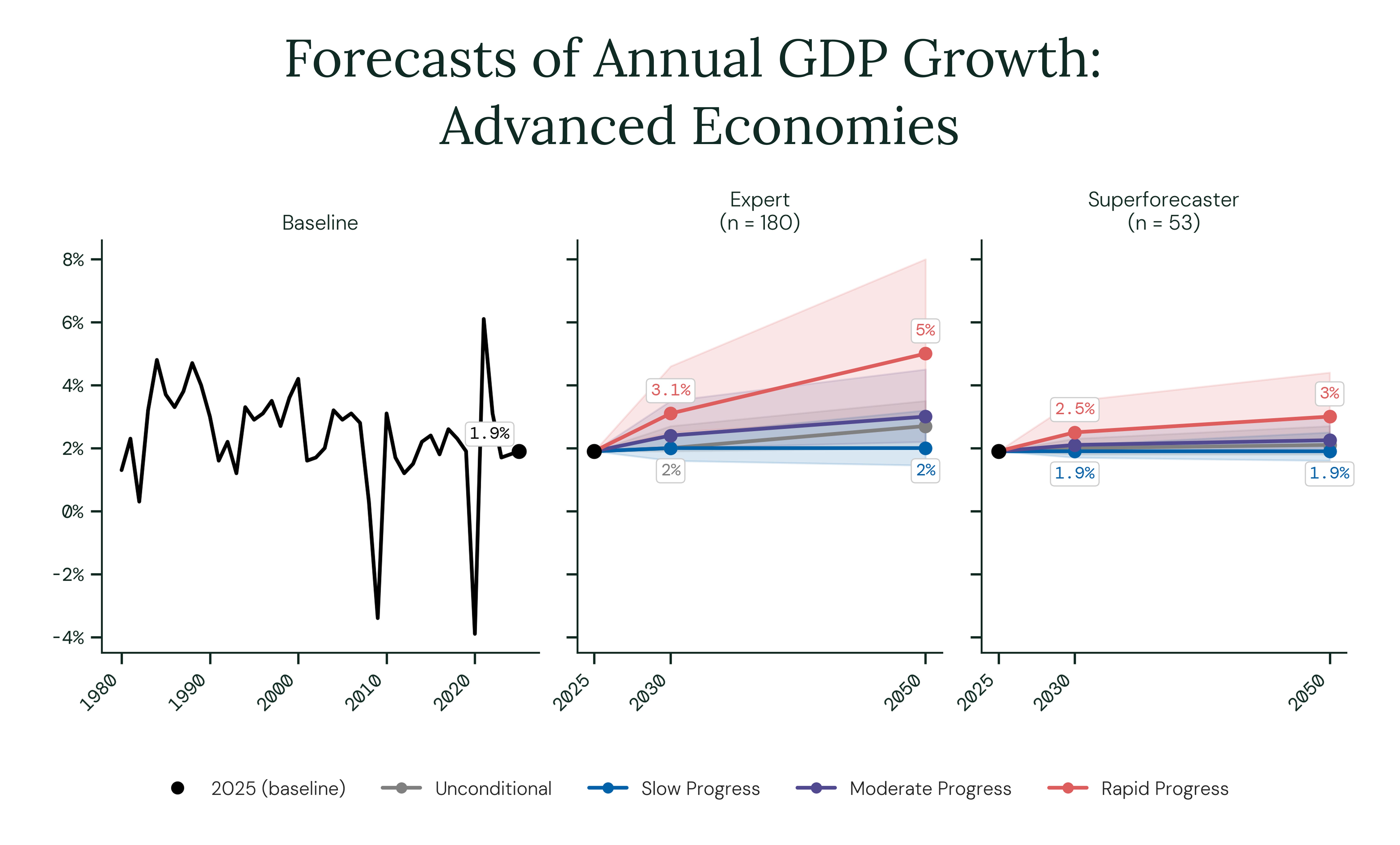
We asked forecasters to predict annualized real GDP growth in advanced economies, and emerging markets and developing countries. Their answers predict a sharp asymmetry, with larger growth gains in richer countries and smaller changes in the developing world.
Advanced economies have grown about 2% a year for the past two decades, but if AI progress is rapid, the median expert expects growth in 2050 to reach 5%—more than double the recent trend. The picture for emerging and developing economies is different. They averaged nearly 6% annual growth in the 2000s and grew 4.4% in 2025, but the median expert expects growth in 2050 to remain close to 6% even under rapid AI progress.
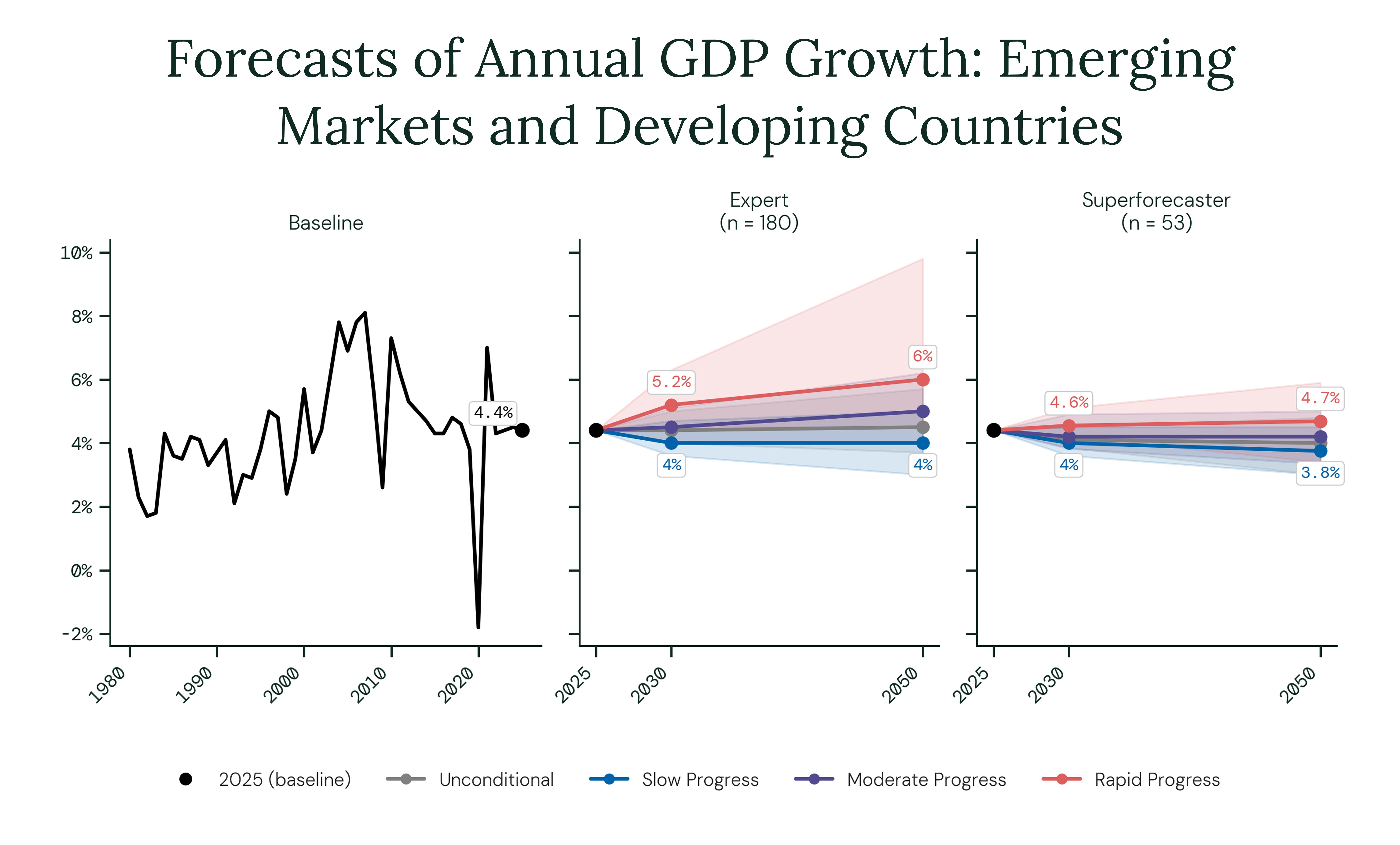
Some respondents argued that AI would destroy the traditional development paths of emerging economies, preventing workers from making the transition from low-productivity to high-productivity jobs. They also argued that robotics and AI could bring manufacturing back to advanced economies, to the disadvantage of emerging economies.
Respondents also thought that much higher rates of growth were possible under a rapid AI progress scenario. The median expert assigned a one-in-ten probability that annualized GDP growth in advanced economies would be at least 10% in 2050. For emerging markets and developing economies, the median expert assigned the same probability that GDP growth in 2050 would be at least 11%.
Insight #4: Experts and superforecasters expect U.S. users to value a month of AI access at about $450 in 2026
Willingness to accept (WTA) measures the payment a person would require to give up a technology for a given period. We asked our panelists to predict the mean WTA among U.S. adult chatbot users. Unconditionally, the median expert and superforecaster put the 2026 value at about $450 a month, roughly $5,400 a year. For comparison, willingness-to-accept experiments in 2019 valued search engines at about $17,530 a year, email at $8,414, and digital maps at $3,648.1
The predicted value of generative AI climbs steeply with time and AI progress. If AI progress is rapid, experts and superforecasters predict that the mean WTA in 2030 will reach $1,500 a month, or roughly $18,000 a year.
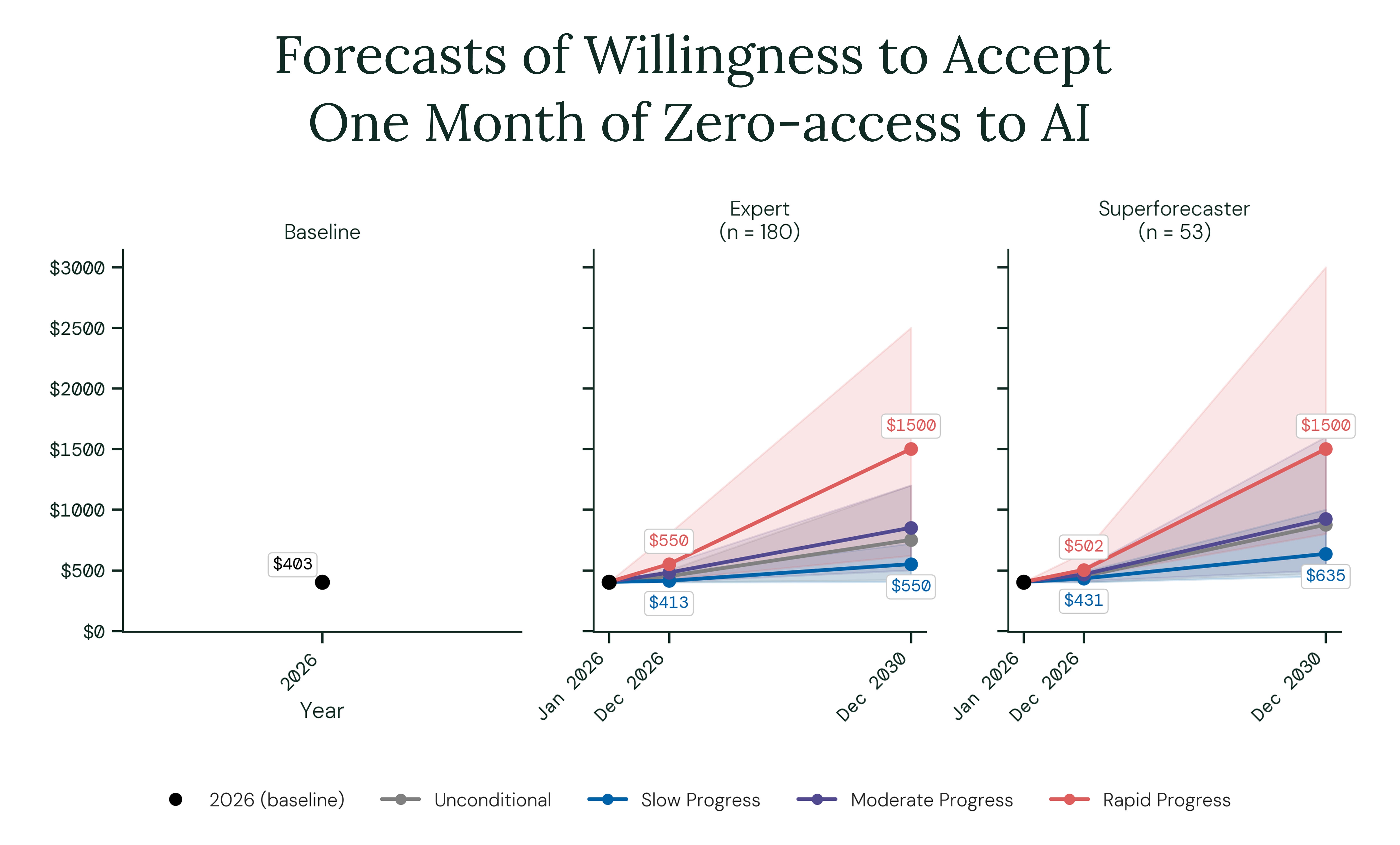
Respondents noted that the mean WTA is dominated by a minority of heavy users with an exceptionally high WTA, with high-WTA respondents predicting that a growing subset of people would pay extremely high amounts to access models. Low-WTA respondents instead tended to predict that as AI use expands, new users would draw down the mean over time.
Insight #5: Forecasters expect global life satisfaction to remain flat, even if AI capabilities progress rapidly
The global population-weighted score on the Gallup World Poll’s 0-to-10 Cantril ladder, a measure of how people evaluate their lives overall, was 5.44 in 2025 and has barely moved in over a decade. Forecasters expect that near-flat path to continue regardless of how fast AI advances. Across most forecaster groups and AI progress scenarios, median forecasts stay within a narrow band, rising only to about 5.5–5.6 by 2040, and no median in any scenario exceeds 6.1.
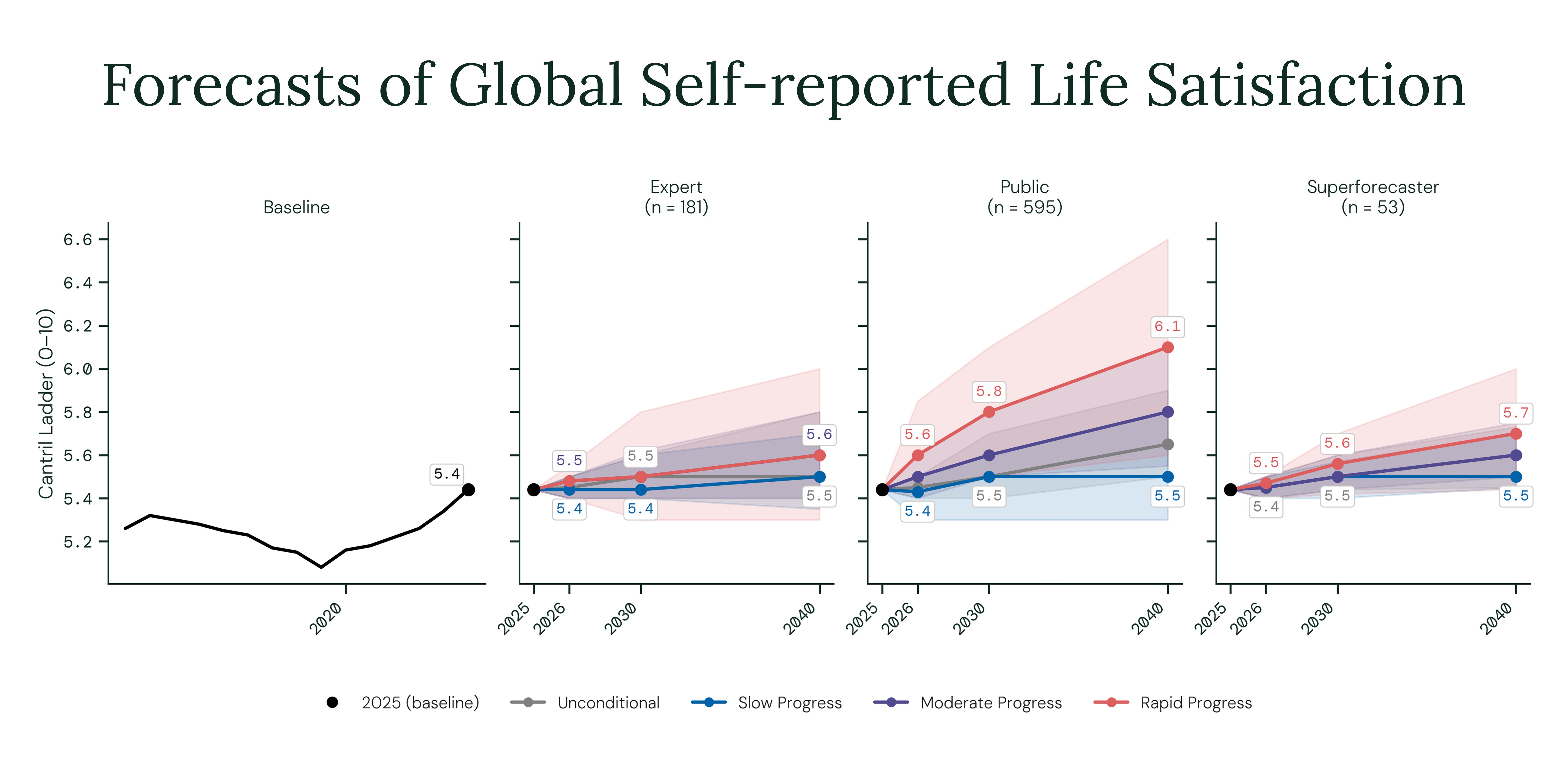
Even as forecasters expect AI to deliver large, measurable gains in health and economic benefit, they doubt these gains will change how satisfied people feel with their lives. Respondents frequently pointed to the stability of the historical trend line, noting that the 2008 financial crisis, the COVID-19 pandemic, and recent inflation had done little to shift self-evaluations of life satisfaction globally. Respondents forecasting flat or lower life satisfaction also noted that wealth stemming from AI adoption would not be broadly shared, and that AI could cause a “crisis in human purpose.”
More from LEAP
This post covers key highlights from the Wave 10 LEAP survey that we conducted between June 16 and July 7, 2026. Recent waves covered robotics, the economic effects of AI, security and geopolitics, AI R&D, and AI timelines.
FRI’s survey included higher bid ladders and other methodological differences. Estimates are not directly comparable but still provide a meaningful frame of reference.